
Below Deck Entertained Me and I'm Still Processing It

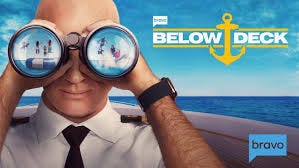
I have opinions about reality television, and most of them are dismissive, and I hold them with some conviction.
I will not watch any of The Real Housewives (let’s be honest, there is very little housewifery involved); the Kardashians are insipid and aggressively plastic; 90 Day Fiancé - I couldn’t tell you. I will, under certain conditions, watch a nature documentary with a host. I have even sat through American Idol without resentment (as long as I can fast forward through the excessive commercials). But the genre built on manufactured conflict, conspicuous wealth, and people who seem to exist primarily to be watched? That I have always kept at arm’s length and with some pride.
And then someone put on Below Deck Sailing Yacht and - critically- I did not leave the room.
I told myself I was just waiting for something, that I was half-watching. By the end of the second episode, I had opinions about the chief stew’s management style and a strong conviction that one of the charter guests deserved to be tipped into the sea.
Here is the thing about Below Deck: the original, Med, Sailing Yacht (I haven’t gotten to Down Under just yet), that I couldn’t explain at first and have spent some time trying to: it is not, at its core, a show about rich people behaving badly. It’s a workplace drama with better lighting and worse boundaries. Or rather, it is, but that’s not why it works. The rich people are almost incidental. They rotate through every few episodes, anonymous and interchangeable in their demands for special dietary accommodations and their inexplicable desire to theme their dinner parties. You don’t really care about them. You’re not supposed to.
What you care about is the crew.
This is, I eventually realized, a workplace drama. It happens to be set on a superyacht, and there happens to be a secondary cast of wealthy guests who function as the equivalent of an impossible deadline or a nightmare client - an external pressure that reveals who these people really are. The real drama is internal: who covers for whom, who crumbles under pressure, who has an absolutely unhinged meltdown at 2am in the crew mess and then has to serve breakfast with a smile six hours later.
The hierarchy aboard a yacht is rigid and frankly medieval. There is a captain. There are departments - interior, deck, galley - each with their own chain of command. There are formal performance reviews that happen on camera, which somehow never stops being surreal. But what no org chart can capture is the specific texture of living with every single person in that hierarchy, around the clock, for weeks at a stretch. Your boss is at breakfast. Your boss is at the crew bar on your one night off. Your boss is never not your boss. There is no commute, no off-switch, no version of the day where the hierarchy relaxes. The boat is the office and the office is also your bedroom and your kitchen and your only social world.
And then, because proximity and exhaustion are apparently excellent decision-makers, people start sleeping together. Which, and I say this as someone who has worked in an office and understands that even the mild version of this is complicated, compounds every existing dynamic in ways the show is only too happy to document. A deckhand and a stew who hooked up on Tuesday still have to work a twelve-hour charter on Wednesday, eat dinner together on Wednesday night, and then figure out what Wednesday was on Thursday morning, all while a camera crew watches and their boss is literally in the next cabin. Below Deck understands that the boat is a pressure cooker and that romance is just another source of heat. You cannot leave. Nobody can leave. Something is always boiling.
As if that weren’t enough, the team itself is new every season. No shared history, no institutional memory, no slow accumulation of trust, just a group of strangers dropped into a high-stakes environment and expected to function immediately. In most workplaces, a difficult colleague is something you learn to navigate over time. On Below Deck, you discover that your coworker is incompetent, volatile, or both sometime around hour three of a twelve-hour shift, and then you simply…. keep working. The show understands that chemistry is not a given; it’s a variable, and often a liability. When it works, it feels miraculous. When it doesn’t, everything frays at once.
And still, without any apparent irony, the show is deeply interested in what it means to be a professional. Do you show up? Do you do your job? Do you keep it together when your boss is making your life actively worse? These are not the questions I expected to be asking while watching a yacht charter reality show, and yet here we are.
And nobody embodies that question more interestingly than the captains themselves, who are each, in their own way, a study in what authority actually looks like under pressure. Captain Lee Rosbach on the original show is the platonic ideal: gruff, laconic, and given to devastating one-liners delivered with the energy of a man who has genuinely seen everything. There’s a moment early on where a deckhand makes some catastrophic error and Lee dresses him down so quietly, so specifically, that it’s almost more unsettling than if he’d yelled. You understand immediately that this man has standards and that falling short of them has consequences (he always has a plane ticket home in his pocket). He is the boss you would absolutely not want to disappoint.
Captain Sandy Yawn on Med is more complicated, which is either a feature or a bug depending on the episode. She is technically accomplished - she talks about her career, her certifications, her years on the water, and you believe every word - but she has a gift for inserting herself into situations in ways that create more chaos than they resolve. There is a category of Below Deck Med scene where Sandy intervenes in a department that is not hers, delivers a correction that the relevant crew member did not need, and then the actual problem gets worse while everyone is distracted by the intervention. I found myself periodically furious at her. And then she would sit down with a young female deckhand or a stew with ambitions above her current rank, and share, with genuine openness, what it cost her to build a career in a field that didn’t particularly want her in it and the frustration would curdle into something more like reluctant admiration. She is maddening precisely because she is also, clearly, the real thing. The show wouldn’t know what to do with a captain who was simply competent and kind. Sandy is more useful to it than that, and probably more interesting to us.
Captain Glenn Shephard on Sailing Yacht is the quiet surprise of the franchise. Where Lee commands through authority and Sandy through intensity, Glenn leads through something that looks almost like equanimity; a steadiness that the sailing format seems to genuinely require. He is the one captain who feels like the boat actually needs him present and paying attention, because the boat can tip over. In one stretch of episodes where the weather turned genuinely bad and the crew was exhausted and scared, Glenn’s calm registered as something real rather than performed. You believed he had done this before. You were glad he was at the helm.
There’s also something bracingly honest about the power dynamics it puts on screen. The guests pay tens of thousands of dollars for a few days aboard, which means the crew - people working 18-hour days, sleeping in small bunks below the waterline, eating their meals in a rotating schedule dictated by service - must absorb almost any behavior with a smile. Below Deck does not particularly editorialize about this. It just shows it. And in that gap, something interesting happens: you start rooting for the crew in a way that feels, unexpectedly, a little political. When a charter guest berates a stew over the thread count of the sheets, you feel it. When the tip comes in low after a brutal trip, you feel that too.
I think what finally got me - what made me stop performing detachment and just admit I was watching - was the sailing season. Below Deck Sailing Yacht adds a layer of actual technical stakes that the motor yacht shows don’t have. The boat can heel. Weather matters. The captain has to make real decisions that have nothing to do with whether the guests want a foam party. There’s a competence element layered on top of everything else, and I am, it turns out, completely helpless in the face of competence on a screen.
I don’t think I’ve become a reality TV person. I still can’t sit through the franchises built entirely on personal grievance and social combat, the ones where the work is just a pretext for the fighting. What Below Deck figured out, or stumbled into, is a container for conflict that actually means something: the job. The boat goes somewhere. There are guests to feed and sails to raise and dishes to clean. Things have to get done. And watching people try to do them under pressure, in close quarters, for people who often don’t deserve the effort turns out to be, against all of my instincts and prior self-assessments, genuinely riveting television.
I was entertained. I have not fully made peace with that.